Q4 Market Volatility
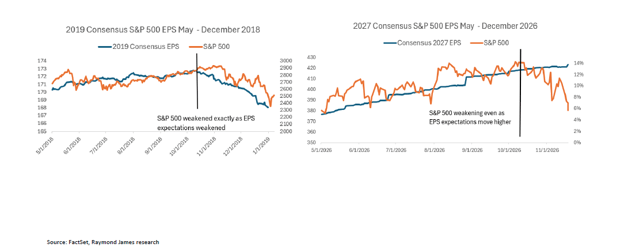
Recent market volatility has understandably raised questions about the economic outlook, the sustainability of AI-related investment, and the direction of interest rates. While these are legitimate considerations, we believe it is important to distinguish between market sentiment and underlying economic and corporate fundamentals. Current S&P 500 earnings expectations continue to move higher even as equity prices have declined. This represents a meaningful departure from periods such as late 2018, when falling stock prices were accompanied by deteriorating earnings expectations. We are also seeing a reset in valuations, with several broader market segments trading at discounts to their long-term historical averages.
We recognize that questions surrounding the financing and ultimate returns of AI infrastructure investments deserve attention and have heard the comparisons likening AI to the Tech Bubble, however, the current financing environment differs meaningfully from the speculative excesses of the early 2000s. Today's credit-market exposure to AI infrastructure is considerably different from the concentration of lower-quality technology and telecommunications credit preceding the dotcom bust. Meanwhile, geopolitical developments and energy prices remain important variables for inflation, interest rates, and corporate profitability. Any moderation in energy prices, alongside continued economic and earnings resilience, could create a particularly favorable environment for smaller companies, domestic businesses, and economically sensitive sectors like consumer discretionary stocks, financials, or industrials.
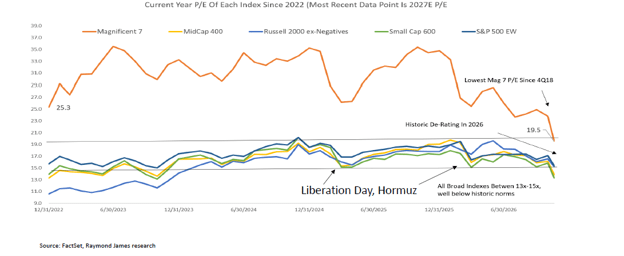
We believe the current environment may be particularly suited to active management. As valuations reset and market leadership broadens, differences in company fundamentals, sector exposures, and industry positioning are becoming increasingly important. Periods of heightened volatility and indiscriminate selling can create opportunities for experienced investment managers who employ rigorous fundamental research and are willing to look beyond the largest companies and most crowded areas of the market. Our approach is to identify and allocate to investment teams with the experience and discipline to navigate these environments, while constructing diversified portfolios with complementary strategies and sources of return.
Most importantly, volatility does not equal, or necessarily imply, irreparable damage to a portfolio. Short-term declines in market prices are an inherent part of investing; permanent capital impairment is a different matter. Our investment philosophy remains centered on owning portfolios of profitable companies, industry leaders, and businesses with durable competitive advantages. We remain disciplined around prices, managers and strategies, and the diversification we maintain across portfolios. We cannot control market volatility, but we can remain thoughtful and disciplined in how we position portfolios through it. We will continue to monitor developments closely and make adjustments when opportunities or risks warrant them. If your personal goals have shifted or circumstances have changed, we encourage you to call to discuss.
The S&P 500 is an unmanaged index of 500 widely held stocks that is generally considered representative of the U.S. stock market. The information contained in this newsletter does not purport to be a complete description of the securities, markets, or developments referred to in this material. The information has been obtained from sources considered to be reliable, but we do not guarantee that the foregoing material is accurate or complete. Any opinions are those of Ehan Keator and not necessarily those of Raymond James. Expressions of opinion are as of this date and are subject to change without notice. There is no guarantee that these statements, opinions or forecasts provided herein will prove to be correct. Investing involves risk and you may incur a profit or loss regardless of strategy selected, including diversification and asset allocation. Past performance does not guarantee future results. Future investment performance cannot be guaranteed; investment yields will fluctuate with market conditions.